On this page
- What Google Actually Wants: People-First Content
- E-E-A-T Explained Simply
- How to Write Content Google Trusts: A 7-Step Process
- Before and After: A Real Rewrite
- Content Quality Scorecard: Check Before You Publish
- What About AI-Written Content?
- Keep Content Fresh
- Content Mistakes That Hurt Trust
- FAQs About SEO Content and E-E-A-T
- Key SEO Terms in This Post
- Wrapping Up
There's a lot of content on the internet now. Thanks to AI, there's more every day. Ask any tool to "write a blog about trekking in Nepal" and you'll get 1,500 smooth, correct-sounding words in seconds.
So here's the real question: if anyone can produce content instantly, why would Google rank yours?
The answer is trust. Google's systems are designed to reward content that's genuinely helpful, written by people who know what they're talking about, and created for readers, not just for search engines. In this guide, I'll explain what that means in plain words, including the famous E-E-A-T, and give you a writing process, a real before/after rewrite, and a scorecard to check your own content.
What Google Actually Wants: People-First Content
Google says its ranking systems aim to show helpful, reliable information created to benefit people, not content made mainly to get search traffic.
People-first content | Search-engine-first content |
|---|---|
Written for a specific audience with a real need | Written to target a keyword, for anyone |
Shows first-hand experience and real knowledge | Summarises what other sites already said |
Leaves the reader feeling they got what they needed | Leaves the reader searching again |
Has a clear purpose beyond ranking | Exists mainly because a topic "gets searches" |
A simple test Google suggests: would you create this content even if search engines didn't exist? If the answer is yes, you're probably writing for people.
E-E-A-T Explained Simply
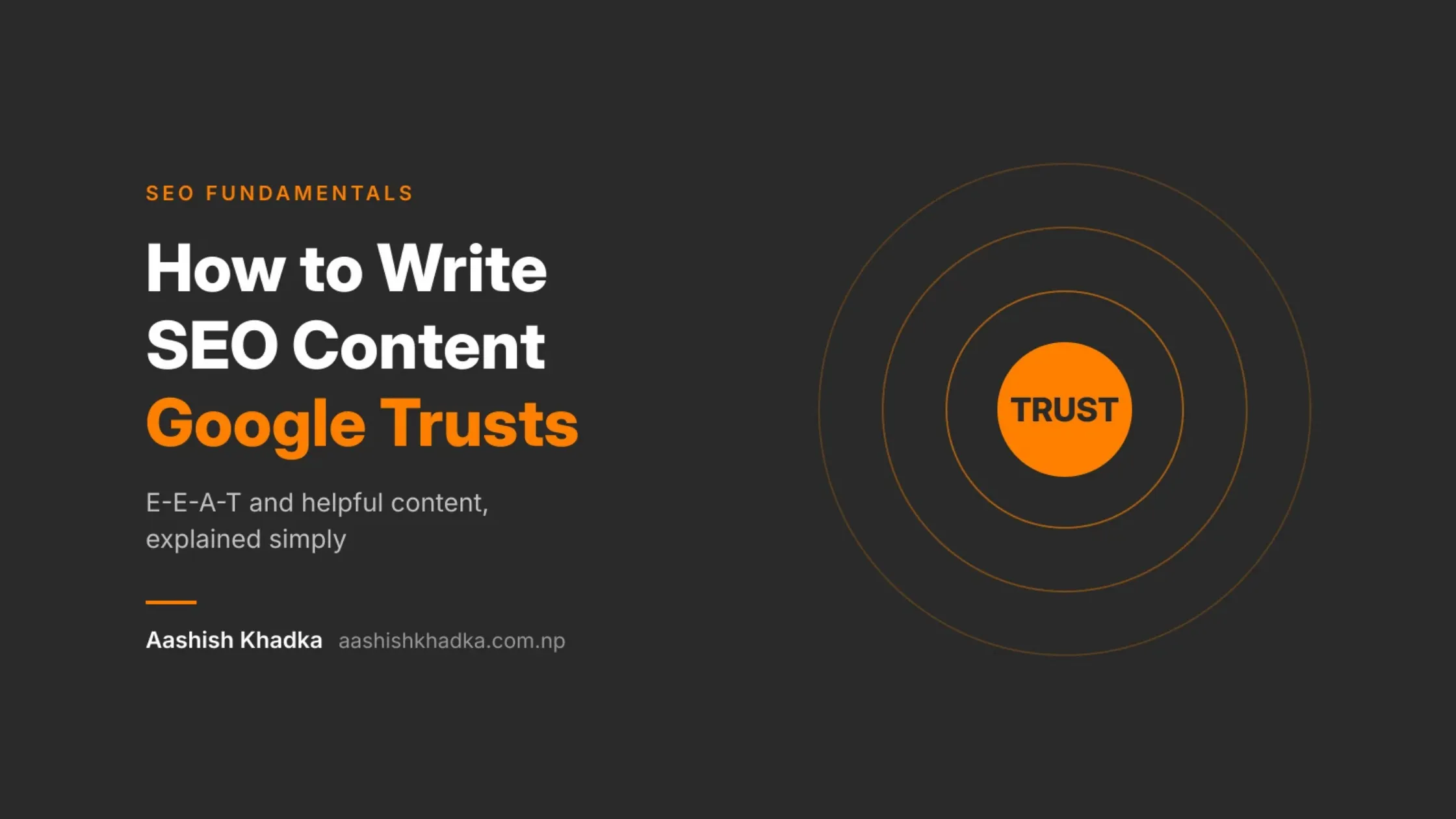
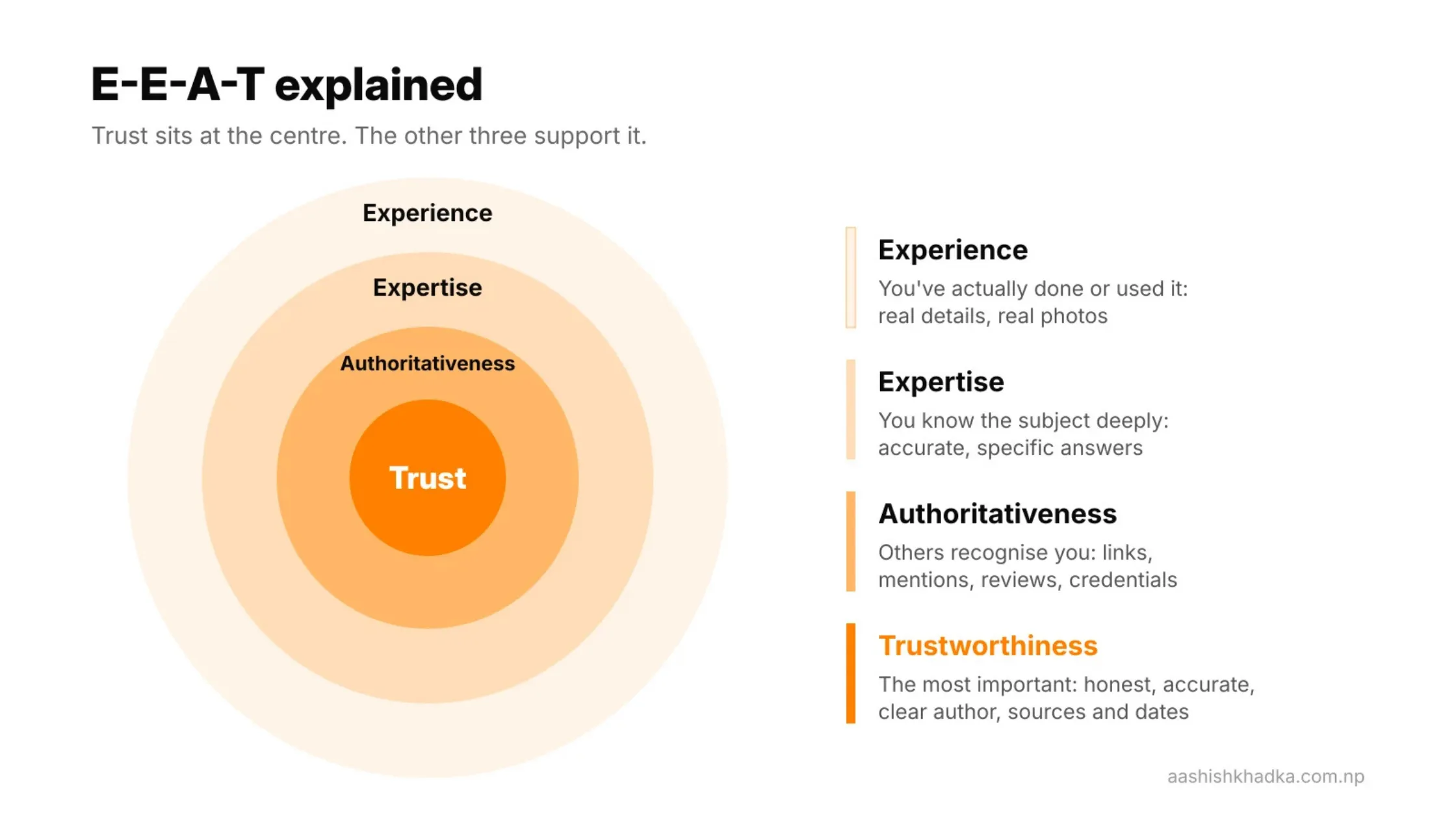
E-E-A-T stands for Experience, Expertise, Authoritativeness and Trustworthiness. It comes from the guidelines Google gives its human quality raters, people who evaluate search results to help Google check that its systems work well.
One important clarification: E-E-A-T is not a single ranking score. Raters don't change rankings directly. But E-E-A-T describes the qualities Google's systems are trying to find, so it's a very good guide for writing content that ranks.
Letter | Means | Shows up in content as | Example |
|---|---|---|---|
Experience | You've actually done or used it | Personal details, real photos, "what happened when…" | "On our last trip in October, the trail above Ghorepani was icy before 7am." |
Expertise | You know the subject deeply | Accurate, specific, correct explanations | Exact permit requirements and why they exist |
Authoritativeness | Others recognise you as a go-to source | Mentions, links, reviews, credentials | Featured in a travel publication; licensed guide |
Trustworthiness | You're honest, accurate and transparent | Clear author, sources, dates, honest limits, contact details | "Prices last checked: [date]"; admitting what doesn't work |
Google describes trust as the most important of the four. The others support it.
Who, How and Why: three questions Google suggests
Question | What to show |
|---|---|
Who created it? | A clear author name, linked to an about page showing their background |
How was it created? | How you tested, researched or know this; if AI helped, how it was used |
Why was it created? | To help people first, not only to attract search traffic |
How to Write Content Google Trusts: A 7-Step Process
Step 1: Start with one reader and one question
Don't write "about a topic". Write for one specific person with one specific question. "A first-time trekker deciding whether Poon Hill is too hard for them" is far easier to write well for than "trekking in Nepal".
Step 2: Check what already ranks, then find your edge
Search your keyword and read the top results. Ask:
What do they all cover? (You'll need that too.)
What do they all miss or get wrong?
What can you add that they can't: real experience, your own photos, data, local knowledge, a clearer explanation?
Your edge is the reason your page deserves to rank. If you can't name one, you're adding another copy.
Step 3: Answer first, then explain
Put the direct answer near the top, then go deeper. Readers who are in a hurry get what they need. Readers who want detail keep going. AI tools also find clear answers easier to quote.
Before (buried answer) | After (answer first) |
|---|---|
Three paragraphs about Nepal's mountains before mentioning difficulty | "Poon Hill is one of the easiest treks in Nepal: most reasonably fit beginners can do it in 4 days. Here's what makes it manageable, and what can still catch you out." |
Step 4: Add what only experience gives you
This is the E that AI can't fake. Add:
Specific details ("the stone steps after Ulleri feel endless")
Real photos you took, not stock images
Mistakes, surprises and honest downsides
Numbers from your own work (with permission if it's client data)
Step 5: Structure it for skimming
Most people skim first. Make that easy: clear H2 and H3 headings, short paragraphs, lists, and tables for comparisons. Good structure helps Google and AI tools understand each section too. [On-Page SEO Checklist]
Step 6: Back up claims and show your work
Link to official or original sources for facts and figures
Never use statistics you can't trace to a real source
Add "last checked" dates for things that change, like prices and rules
Step 7: Show who's behind it
Add an author name and a short bio, link to an About page, and show the date the content was published or updated. Make it easy for readers to see you're a real person or business.
Before and After: A Real Rewrite
Here's the same paragraph written two ways.
Before (generic, could be anyone):
"Trekking in Nepal is an amazing experience. Nepal has many beautiful treks for all levels. It is important to choose the right trek and prepare properly. Our company offers the best trekking packages in Nepal with experienced guides."
After (helpful, specific, trustworthy):
"If it's your first trek in Nepal and you have 4–5 days, Poon Hill is the safest bet: maximum altitude around 3,210 m, teahouses every few hours, and a sunrise viewpoint that delivers on clear mornings. The hardest part isn't the altitude, it's the long stone staircase on day one. Below, I'll break down each day, what it costs, and which months give you the best chance of clear views."
What changed | Why it matters |
|---|---|
Answers a specific question for a specific reader | Matches search intent |
Specific facts (days, altitude, terrain) | Shows expertise |
An honest "hardest part" detail | Shows experience and builds trust |
Tells the reader what's coming | Helps them decide to keep reading |
No empty claims like "the best" | Removes what readers ignore anyway |
Note: always double-check facts like altitudes and permit rules against current official sources before publishing.
Content Quality Scorecard: Check Before You Publish
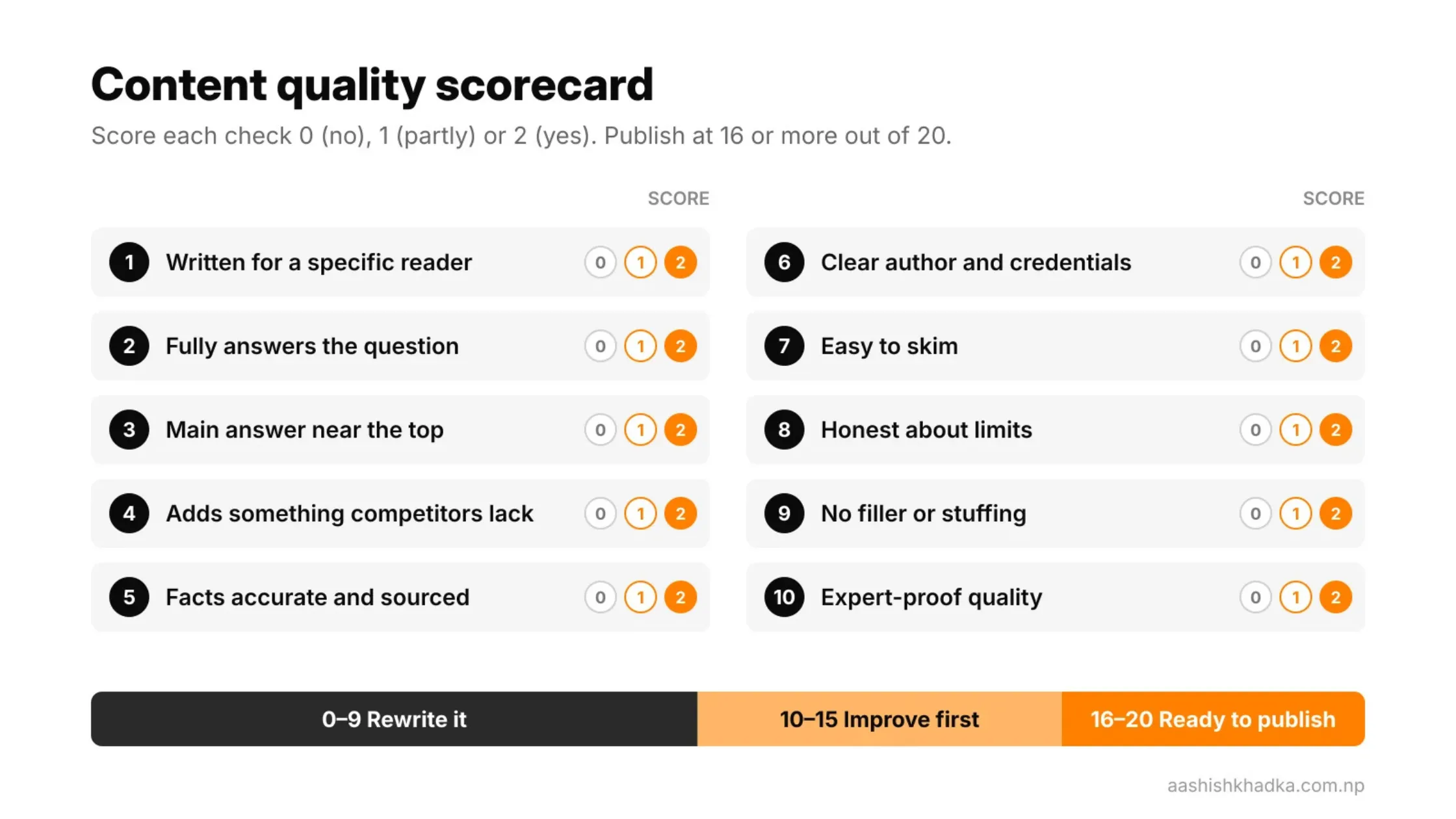
Score each question 0 (no), 1 (partly) or 2 (yes). Aim for 16 or more out of 20 before publishing.
# | Question | Score (0–2) |
|---|---|---|
1 | Is it written for a specific reader with a specific need? | |
2 | Does it fully answer the question, so they don't need to search again? | |
3 | Is the main answer near the top? | |
4 | Does it include something competitors don't have (experience, data, examples)? | |
5 | Are facts accurate and checked against reliable sources? | |
6 | Is it clear who wrote it and why they're qualified? | |
7 | Is it easy to skim (headings, short paragraphs, lists, tables)? | |
8 | Is it honest about limits, downsides and what doesn't work? | |
9 | Is it free of filler, repetition and keyword stuffing? | |
10 | Would you be proud to show it to an expert in this field? |
What About AI-Written Content?
Google's position is that it rewards helpful content, however it's produced. Using AI isn't against the rules on its own. What's against the rules is using any method, AI or human, to mass-produce low-value pages mainly to manipulate rankings. Google calls this scaled content abuse.
Fine | Risky |
|---|---|
Using AI to outline, brainstorm or edit your own expert writing | Publishing hundreds of unedited AI pages to target every keyword |
AI helping you explain something clearly, then you add real experience and check facts | AI-written "reviews" of things nobody actually tried |
Being transparent about how content was made where readers would expect it | Copying and lightly rewording other sites' content at scale |
The practical rule: AI can help you write, but it can't give you experience. The parts that make content trustworthy (real details, real photos, real opinions, checked facts) have to come from you.
Keep Content Fresh
Trust also means staying accurate. Prices change, rules change, tools change.
Review your most important pages every few months
Update facts, screenshots and examples, and change the "last updated" date only when you've made real changes
Merge thin, overlapping posts into one stronger guide
Remove or redirect pages that are outdated and can't be saved
You can spot pages that are slipping in Google Search Console. [Google Search Console for Beginners]
Content Mistakes That Hurt Trust
Mistake | Why it hurts | Fix |
|---|---|---|
Generic content anyone could write | Nothing makes it better than what already ranks | Add experience, data, examples |
Unsourced statistics | Readers and Google can't verify them | Cite real sources or remove them |
Fake experience or invented stories | Destroys trust if noticed | Only share what really happened |
Writing to a word count | Filler makes content worse | Write until the question is fully answered |
No author or contact details | Hard to know who to trust | Add author bio and About page |
Never updating | Outdated info misleads readers | Review key pages regularly |
FAQs About SEO Content and E-E-A-T
Is E-E-A-T a ranking factor?
Not directly as a single score. E-E-A-T comes from Google's guidelines for human quality raters. But Google's systems look for many signals that line up with it, so content that shows experience, expertise, authority and trust tends to perform better.
How long should an SEO blog post be?
As long as it takes to fully answer the question, and no longer. Look at what ranks for your keyword as a rough guide, then aim to be more useful, not just longer.
Can I use AI to write SEO content?
Yes, as a helper. Google rewards helpful content regardless of how it's made, but mass-producing low-value pages is against its spam policies. Add your own experience, check every fact, and edit heavily.
How do I show experience if I'm new?
Share what you've genuinely tried, tested or learned, including mistakes. Use your own photos and examples. Honest beginner experience is more trustworthy than pretending to be an expert.
How often should I update old content?
Review your most important pages every few months, and immediately when something important changes, like prices, rules or tools.
Key SEO Terms in This Post
Term | Meaning |
|---|---|
E-E-A-T | Experience, Expertise, Authoritativeness, Trustworthiness |
People-first content | Content created mainly to help readers, not to game search |
Quality raters | People who evaluate search results to help Google check its systems |
Search intent | What the searcher actually wants |
Scaled content abuse | Mass-producing low-value pages to manipulate rankings |
Thin content | Pages with little useful information |
Content refresh | Updating existing content to keep it accurate and useful |
Wrapping Up
The secret to SEO content isn't a secret at all: write the most helpful, honest answer to a real person's question, and make it obvious that a real, qualified person wrote it.
In a world full of instant AI content, the things that make you stand out are exactly the things AI can't produce for you: your experience, your photos, your data and your honest opinions.
Next in the series: how to connect all your pages so Google (and readers) can find everything. [Internal Linking for SEO: How to Structure Your Site So Every Page Can Rank]
Want a second opinion on your content? Get in touch.