On this page
- The Simple Definitions
- How They Compare
- SEO: The Foundation Everything Else Needs
- AEO: Be the Clear Answer
- GEO: Get Cited and Recommended by AI
- Where Should a Small Business Focus? A Priority Plan
- How to Measure AI Search Visibility
- GEO Myths to Ignore
- FAQs About SEO, AEO and GEO
- Key SEO Terms in This Post
- Wrapping Up
Every few months, someone announces that SEO is dead. First it was voice search, then featured snippets, now AI. Suddenly there are new acronyms everywhere: AEO, GEO, LLMO, AIO. Agencies are selling "GEO packages". Business owners are confused.
So let's clear it up. In this post, I'll explain what SEO, AEO and GEO actually mean, how they overlap, what's genuinely different, and, most importantly, where a small business should actually focus its time.
Spoiler: you don't need three separate strategies. But you do need to understand how AI is changing what "being found" means.
The Simple Definitions
Term | Stands for | Goal | Where it shows up |
|---|---|---|---|
SEO | Search Engine Optimization | Rank in search results and get clicks | Google and Bing's normal results |
AEO | Answer Engine Optimization | Be the direct answer to a question | Featured snippets, People Also Ask, voice assistants |
GEO | Generative Engine Optimization | Be cited or recommended in AI-generated answers | Google AI Overviews and AI Mode, ChatGPT, Perplexity, Claude, Gemini |
Think of them as three ways of being found:
SEO: "Here are ten websites that might help you."
AEO: "Here's the answer, taken from this website."
GEO: "Here's a summary I wrote using these sources, and here's who I'd recommend."
How They Compare
SEO | AEO | GEO | |
|---|---|---|---|
What "winning" looks like | Ranking high in results | Your answer shown directly | Your brand cited or recommended by AI |
What the user sees | A list of links | One highlighted answer | A written answer with sources |
Main success metric | Rankings, clicks, traffic | Snippet ownership, visibility | Citations, mentions, AI referrals |
Content style that wins | Complete, helpful pages | Clear, direct answers to questions | Clear facts, structure and trusted third-party mentions |
How established | Decades of experience and tools | Several years, well understood | New and still changing fast |
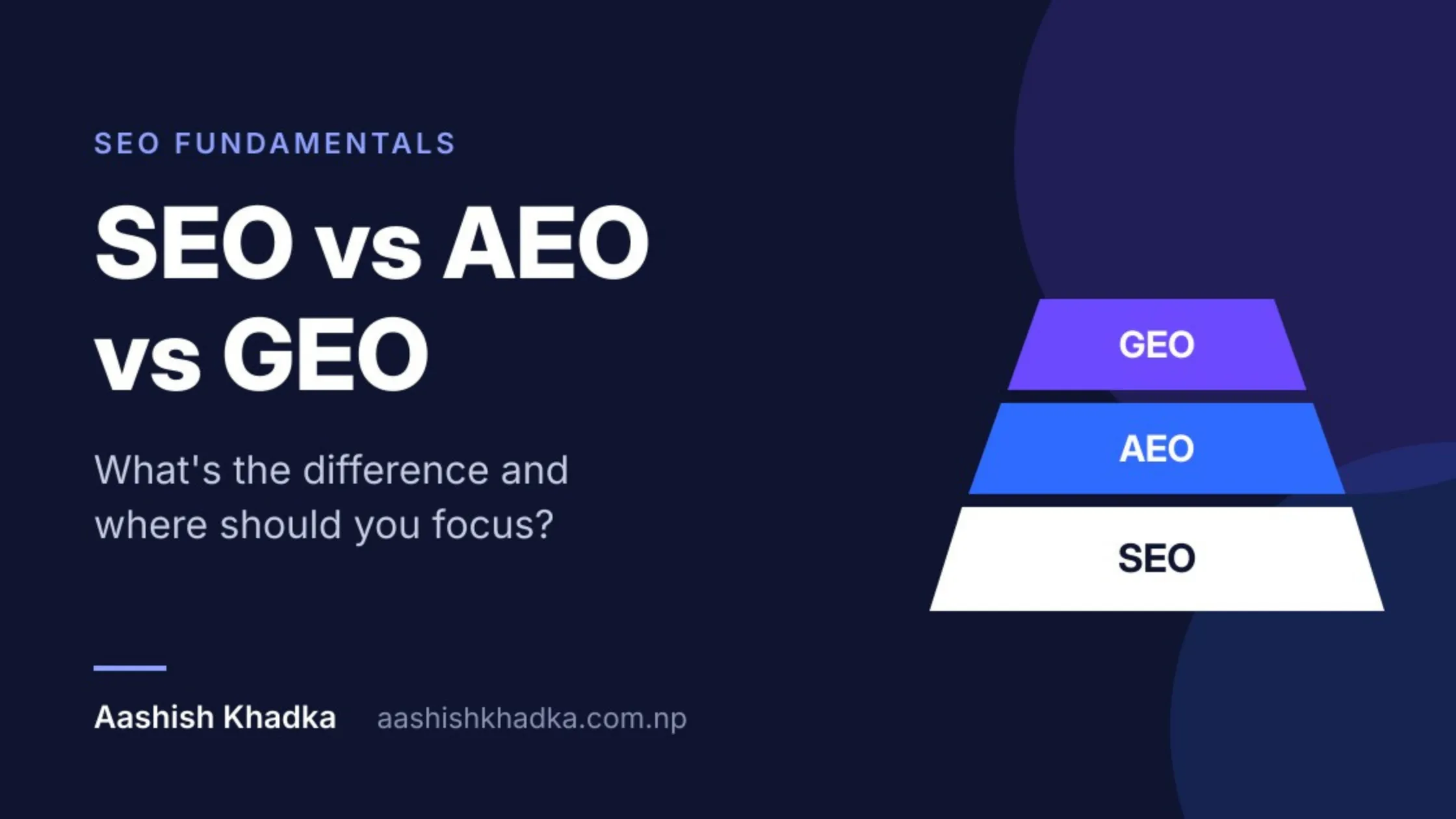
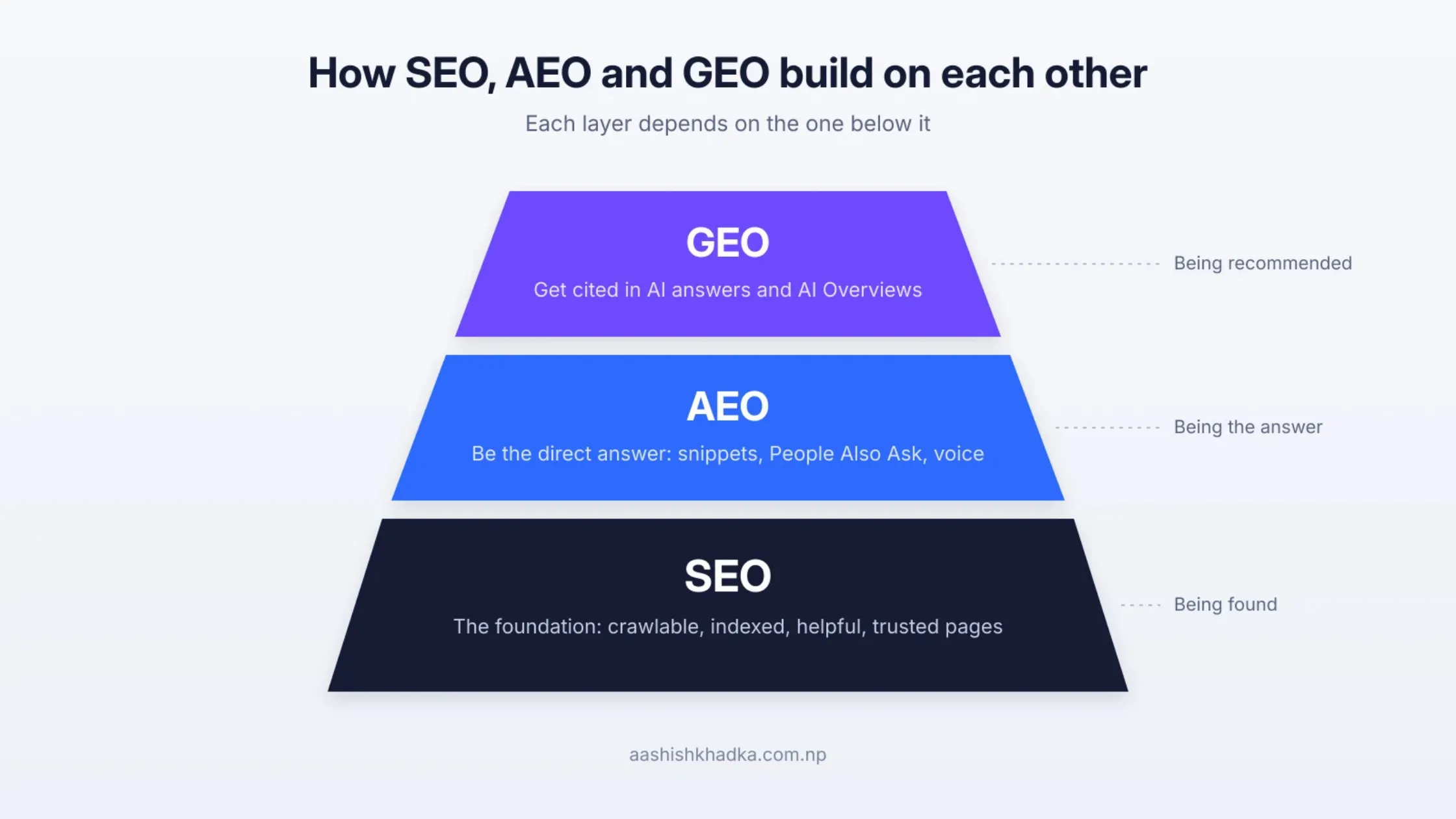
The key point: they overlap massively. AEO is really a part of good SEO, and GEO builds on the same foundation. Google itself says its AI features rely on the same core SEO best practices, with no special AI files or markup required.
SEO: The Foundation Everything Else Needs
SEO is still the base layer. If search engines and AI crawlers can't reach, understand and trust your pages, nothing else works.
What matters most:
Crawlable, indexable pages that load fast and work on mobile [What is Technical SEO?]
Helpful content that matches what people search [How to Do Keyword Research for Free]
Strong on-page structure: titles, headings, internal links [On-Page SEO Checklist]
Authority from links, mentions and reviews [Off-Page SEO]
Google's AI Overviews and AI Mode draw on Google's normal search index. So if you're not indexed and trusted in regular search, you're very unlikely to appear in Google's AI features either.
AEO: Be the Clear Answer
AEO focuses on questions. When someone asks "how long is the Poon Hill trek?", search engines and voice assistants want one clear answer they can show or read out.
How to optimise for it:
Do this | Example |
|---|---|
Use real questions as headings | "How long is the Poon Hill trek?" |
Answer directly in the first 1–2 sentences under it | "Most people complete the Poon Hill trek in 4 days from Pokhara." |
Then add detail, context and exceptions | Shorter and longer versions, who each suits |
Use lists and tables for steps and comparisons | Day-by-day table, cost table |
Cover the follow-up questions | Collect them from People Also Ask |
This is simply clear, well-structured writing, which is also good SEO and good GEO.
GEO: Get Cited and Recommended by AI
GEO is about AI tools that write an answer and cite sources, like ChatGPT, Perplexity, Claude, Gemini and Google's AI features. Two things are different here:
AI tools often pull several sources and combine them, so you're competing to be one of the cited sources, not just position one.
AI tools form a view of your brand from the whole web, not just your website: reviews, news, community discussions, directories and comparison articles.
How to optimise for it:
Area | What to do |
|---|---|
Access | Don't accidentally block AI search crawlers (like OAI-SearchBot, PerplexityBot or Claude-SearchBot) in robots.txt or your firewall, if you want to appear in those tools |
Readable pages | Make sure your main content is in the page's HTML, not only loaded by JavaScript |
Extractable content | Clear headings, direct answers, facts, tables and lists AI can quote accurately |
Original value | Your own data, experience and examples, which give AI something unique to cite |
Entity clarity | Consistent business name, details and profiles everywhere; structured data [Internal link: Schema Markup Explained] |
Third-party mentions | Reviews, press, community recommendations and listings on trusted sites |
Freshness | Dated, updated content, especially for prices, rules and comparisons |
The biggest difference from classic SEO: what others say about you matters even more. A business that's genuinely recommended across reviews, articles and communities is much easier for AI to recommend.
Where Should a Small Business Focus? A Priority Plan
You don't need three teams or three budgets. Work in this order, because each layer builds on the one before:
Priority | Focus | Why first | Key actions |
|---|---|---|---|
1 | SEO foundation | Without it, nothing else works | Fix indexing and speed, build helpful pages, set up Search Console |
2 | Local presence and reviews | Fast wins for local businesses, and AI tools use them | Complete Google Business Profile, collect honest reviews, consistent listings |
3 | Answer-first content (AEO) | Easy to apply to content you're writing anyway | Question headings, direct answers, FAQs, tables |
4 | Mentions and authority (GEO) | Builds what AI tools look for | PR, community participation, partnerships, original data |
5 | AI-specific checks | Small but important | Check AI crawler access, test prompts monthly, track AI referrals |
If you do steps 1–4 well, you're already doing most of what "GEO" is.
How to Measure AI Search Visibility
Measuring AI visibility is still messy, but you can start for free:
Method | What it shows |
|---|---|
Search Console generative AI reports (rolling out since June 2026) | How often your pages appear in Google's AI Overviews and AI Mode |
Analytics referrals | Visits from chatgpt.com, perplexity.ai, claude.ai, gemini.google.com and similar |
Monthly prompt testing | Ask 10–20 questions your customers would ask in ChatGPT, Perplexity and Google AI Mode; note who gets cited |
Paid AI visibility tools | Tracking at scale, worth it only once you're actively working on this |
Record your prompt tests in a simple spreadsheet each month: the question, the tool, who was cited, and whether you appeared. Over time, that's your GEO scorecard.
GEO Myths to Ignore
Myth | Reality |
|---|---|
"SEO is dead, only GEO matters now" | AI search depends on the same foundations. Google's AI features use its normal index |
"You need an llms.txt file to appear in AI" | Google has said it doesn't use llms.txt. It may help some tools, but it's optional, not a magic switch |
"GEO needs special AI markup" | Google says no special files or markup are needed for its AI features |
"You can guarantee ChatGPT recommendations" | Nobody controls AI answers; you can only improve your chances |
"Blocking all AI bots protects you" | Blocking AI search crawlers can remove you from their answers. Decide per bot type |
"Write for AI, not humans" | Clear, helpful content for people is exactly what AI tools cite |
FAQs About SEO, AEO and GEO
What is the difference between SEO and GEO?
SEO aims to rank your pages in search results so people click. GEO aims to get your brand cited or recommended inside AI-generated answers. GEO builds on SEO; it doesn't replace it.
Is AEO the same as GEO?
Not quite. AEO is about being the direct answer (featured snippets, voice answers). GEO is about being one of the sources AI tools use when they write a longer answer. The tactics overlap a lot.
Do I need a separate GEO strategy?
For most small businesses, no. Strong SEO, answer-first content, reviews and genuine mentions cover most of it. Add simple AI-specific checks like crawler access and monthly prompt testing.
How do I get my business recommended by ChatGPT?
Make your site crawlable by its search crawler, publish clear and helpful content, keep your business details consistent, and build real reviews and mentions on trusted sites. There's no guaranteed method.
Is SEO still worth it in the AI era?
Yes. AI search still depends on finding and trusting websites, and Google's AI features are built on its search index. SEO is the foundation of AI visibility.
Key SEO Terms in This Post
Term | Meaning |
|---|---|
SEO | Search Engine Optimization: ranking in search results |
AEO | Answer Engine Optimization: being the direct answer |
GEO | Generative Engine Optimization: being cited in AI answers |
AI Overviews | Google's AI-written summaries at the top of some results |
AI Mode | Google's conversational AI search experience |
Featured snippet | A highlighted answer box at the top of Google results |
Citation | (In AI search) a source linked or named in an AI answer |
Entity | A clearly identifiable thing, like your business, a person or a place |
AI crawler | A bot that collects pages for an AI company, for training or search |
Wrapping Up
SEO, AEO and GEO aren't three competing strategies. They're three layers of the same goal: being the most trusted, clearest answer, wherever people search.
Get the SEO foundation right, write answer-first content, build a genuine reputation across the web, and check that AI tools can actually reach you. Do that, and you're ready for Google, for answer boxes and for AI, whatever acronym comes next.
This wraps up my SEO fundamentals series. Start from the beginning here: [What is SEO and How Does It Work?] or go deeper with [Advanced Technical SEO for the AI Era].
Want to know how visible your business is in AI search? Get in touch.