
On this page
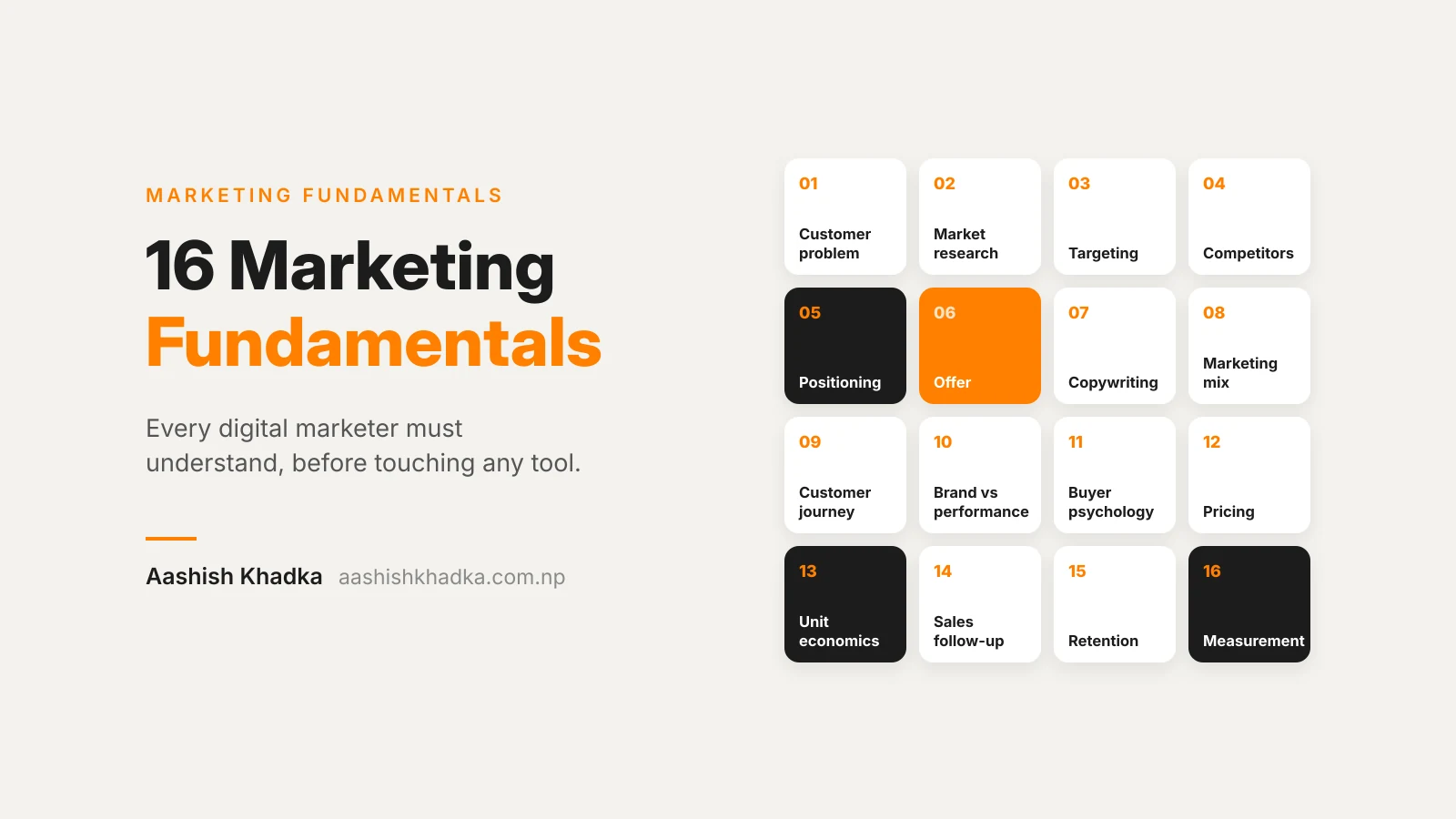
- The 16 Fundamentals at a Glance
- 1. Marketing Starts With a Customer Problem, Not a Product
- 2. Market Research and Customer Insight: Stop Guessing
- 3. Segmentation and Targeting: You Can't Market to Everyone
- 4. Competitor Analysis: Know Who Else They're Considering
- 5. Positioning: Why You, Not the Business Next Door?
- 6. Value Proposition and Offer: Make It Easy to Say Yes
- 7. Messaging and Copywriting: Clear Beats Clever
- 8. The Marketing Mix: Marketing Is More Than Promotion
- 9. The Customer Journey: Meet People Where They Are
- 10. Brand vs Performance Marketing: Build Demand, Don't Just Capture It
- 11. Buyer Psychology: How People Really Decide
- 12. Pricing: Price Is Part of Your Message
- 13. Unit Economics: Is Your Marketing Actually Profitable?
- 14. Marketing Doesn't End at the Lead: Sales and Follow-Up
- 15. Retention and Word of Mouth: The Cheapest Growth There Is
- 16. Measurement and Testing: Decide With Data, Not Feelings
- Putting It All Together: A One-Page Checklist Before Any Campaign
- Common Mistakes Digital Marketers Make
- FAQs
- Key Marketing Terms in This Post
- Wrapping Up
Here's something I see all the time. A business hires someone who knows Meta Ads Manager inside out. The ads look great. The reach is huge. And sales don't move.
The problem usually isn't the ads. It's the marketing underneath: the wrong audience, a weak offer, no clear reason to choose this business over the one next door.
Digital marketing is marketing, done with digital tools. The tools change every year. The fundamentals have stayed the same for decades. If you understand them, every tool becomes easier, and your campaigns start actually selling.
I learned most of this by doing real work for real businesses, not in a classroom. Here's that story.
These are the 16 fundamentals I think every digital marketer should understand before getting deep into any platform. I'll explain each one in simple words, with examples from real types of businesses here in Pokhara.
The 16 Fundamentals at a Glance
# | Fundamental | The question it answers |
|---|---|---|
1 | Marketing starts with a problem | What does the customer actually need? |
2 | Market research and customer insight | What do customers really think and say? |
3 | Segmentation and targeting | Who exactly are we marketing to? |
4 | Competitor analysis | Who else are they considering, and how do we compare? |
5 | Positioning | Why should they choose us over others? |
6 | Value proposition and offer | What exactly do they get, and why now? |
7 | Messaging and copywriting | How do we say it so people act? |
8 | The marketing mix | Is the product, price, place and promotion right? |
9 | The customer journey | Where is the customer in their decision? |
10 | Brand vs performance marketing | Are we building demand or only capturing it? |
11 | Buyer psychology | Why do people really decide? |
12 | Pricing | How does price shape what people think of us? |
13 | Unit economics | Is our marketing actually profitable? |
14 | Sales and follow-up | Are enquiries turning into customers? |
15 | Retention and word of mouth | Do customers come back and bring others? |
16 | Measurement and testing | How do we know what's working? |
1. Marketing Starts With a Customer Problem, Not a Product
What it is
People don't buy products. They buy solutions to their problems, or a better version of themselves. Marketing starts by understanding that problem and the outcome the customer wants, then showing how your product gets them there.
What the business sells | What the customer actually wants |
|---|---|
Hotel room in Lakeside | A peaceful stay close to everything, without stress |
Trekking package | A safe adventure they'll remember, with nothing going wrong |
Gym membership | To look and feel better, and stay consistent |
Website design | More enquiries and a business that looks trustworthy |
Why it matters for digital marketers
Online, you have about two seconds to make someone stop scrolling. People stop for things that speak to their situation, not for a list of your product features. Problem-first messages get more attention, more clicks and better-quality enquiries.
Example
A Lakeside guesthouse runs an ad saying "Rooms available, 20 rooms, AC, Wi-Fi". Few clicks. They change it to "Just got off a 7-hour bus? Rest 2 minutes from the lake, with hot showers and a quiet room." Same rooms, but now the ad speaks to what a tired traveller actually feels.
Common mistake
Starting with the product ("We are the best digital agency with 10 services") instead of the customer's problem ("Getting messages on Facebook but no bookings?").
How to apply it
Write one sentence: "Our customer is struggling with ___, and we help them ___."
List the 3 biggest problems your customers have before they find you.
For each product or service, write the outcome the customer gets, not what it is.
Start every ad, post and landing page headline with the problem or the outcome.
2. Market Research and Customer Insight: Stop Guessing
What it is
Market research means finding out what your customers actually think, want and say, before you decide what to market and how. You don't need a big budget. Most of the best research is free.
Research method | What you learn | How to do it (free) |
|---|---|---|
Talk to customers | Why they bought, what almost stopped them, what words they use | 5–10 short conversations, in person, by phone or on WhatsApp |
Read reviews (yours and competitors') | What people love and what they complain about | Google Maps, TripAdvisor, Facebook reviews |
Check search data | What people actually search for, and how they phrase it | Google autocomplete, People Also Ask, Search Console |
Read comments and messages | Real questions and objections | Your DMs, comments, WhatsApp chats |
Ask front-line staff | The questions customers ask every day | Reception, sales or delivery staff |
Run a short survey | Patterns across many customers | Google Forms with 3–5 questions |
Why it matters for digital marketers
Most marketing is built on assumptions: "Our customers care about price." "Tourists want luxury." Sometimes they're right. Often they're not, and every campaign built on them wastes money. Research also gives you voice of customer: the exact words people use, which make your ads and pages feel like they were written just for them.
Example
A homestay owner thinks guests love the "traditional architecture". But after reading 50 reviews, the phrase that keeps appearing is the host's home-cooked dal bhat. That becomes the headline, the first photo and the hook for every reel, and enquiries go up because the marketing now matches what guests actually value.
Common mistake
Asking friends and family what they think instead of asking real customers, or skipping research completely because "we already know our market".
How to apply it
Talk to 5 real customers. Ask: What made you start looking? What else did you consider? What almost stopped you? What would you tell a friend about us?
Read 30 reviews in your market, both yours and competitors'.
Write down words and complaints that repeat.
Use those exact words in your ads, captions and page headlines.
For search research, see my guide on keyword research for free.
3. Segmentation and Targeting: You Can't Market to Everyone
What it is
Segmentation means dividing a market into groups of people with similar needs.
Targeting means choosing which group (or groups) you'll focus your marketing on.
Segment by | Example for a Pokhara cafe |
|---|---|
Location | Locals in Lakeside vs tourists staying nearby |
Demographics | Students, young professionals, families |
Behaviour | Remote workers who need Wi-Fi, people meeting friends |
Needs | A quick coffee vs a long, quiet working session |
Why it matters for digital marketers
Every ad platform asks you who to target. If you don't know, you either target everyone (and waste money on people who'll never buy) or let the platform guess. A clear target also tells you what to post, which keywords to use and which platform to focus on.
Example
Two cafes in Lakeside. One targets "everyone" and posts random food photos. The other targets remote workers and posts about fast Wi-Fi, power sockets at every table and quiet corners, and runs ads to people near Lakeside interested in remote work and travel. The second cafe gets a loyal group of customers who come back every day.
Common mistake
Targeting "everyone in Nepal" or "all ages, all interests" because it feels like more potential customers. It almost always means more cost and fewer sales.
How to apply it
List 3–4 possible customer groups for your business.
For each, note how much they spend, how often they buy and how easy they are to reach.
Pick one main group to focus on first.
Describe that customer in detail: who they are, what they need, where they search and scroll, and what makes them hesitate.
4. Competitor Analysis: Know Who Else They're Considering
What it is
Studying the other options your customer is comparing you with: what they offer, what they say, what they charge, and what customers say about them.
Direct competitors sell the same thing to the same people: another cafe in Lakeside.
Indirect competitors solve the same problem differently: a bakery, a hotel restaurant, or making coffee at the guesthouse.
Why it matters for digital marketers
Your customer is never only looking at you. They're comparing you, often in the same Google search results or on the same Instagram feed. If you sound exactly like everyone else, they'll choose on price or convenience. Competitor analysis shows you the gaps you can fill.
What to check | Why it matters | Where to look (free) |
|---|---|---|
Their offer and prices | Sets what customers expect | Their website, social pages, booking sites |
Their main message | Shows how they're positioned, and what's left for you | Homepage headline, Instagram bio, ads |
Their reviews | Complaints = gaps you can fill. Praise = the minimum you must match | Google Maps, TripAdvisor, Facebook |
Their search presence | Which searches they win, and which they don't | Search the main keywords yourself; free SEO tools |
Their content | Which topics and formats get engagement | Instagram, TikTok, YouTube, their blog |
Their ads | What they're spending money to say | Meta Ad Library and Google Ads Transparency Center (both free and public) |
For local businesses, your competitors on Google Maps matter most. See my local SEO guide.
Example
You check five trekking companies. Every one says "best price, experienced guides". But their reviews repeat one complaint: "extra costs we weren't told about". That's your opening: "Transparent pricing, no hidden costs", with a full cost breakdown on every trek page.
Common mistake
Copying a competitor's ads and content. If you copy them, you become the second-best version of them.
How to apply it
List 3–5 competitors, including at least one indirect one.
Make a table: price, main message, star rating, top complaint, what they're missing.
Look them up in Meta Ad Library. Ads that have run for months are often the ones that work.
Write down one thing you can honestly offer or say that none of them do.
5. Positioning: Why You, Not the Business Next Door?
What it is
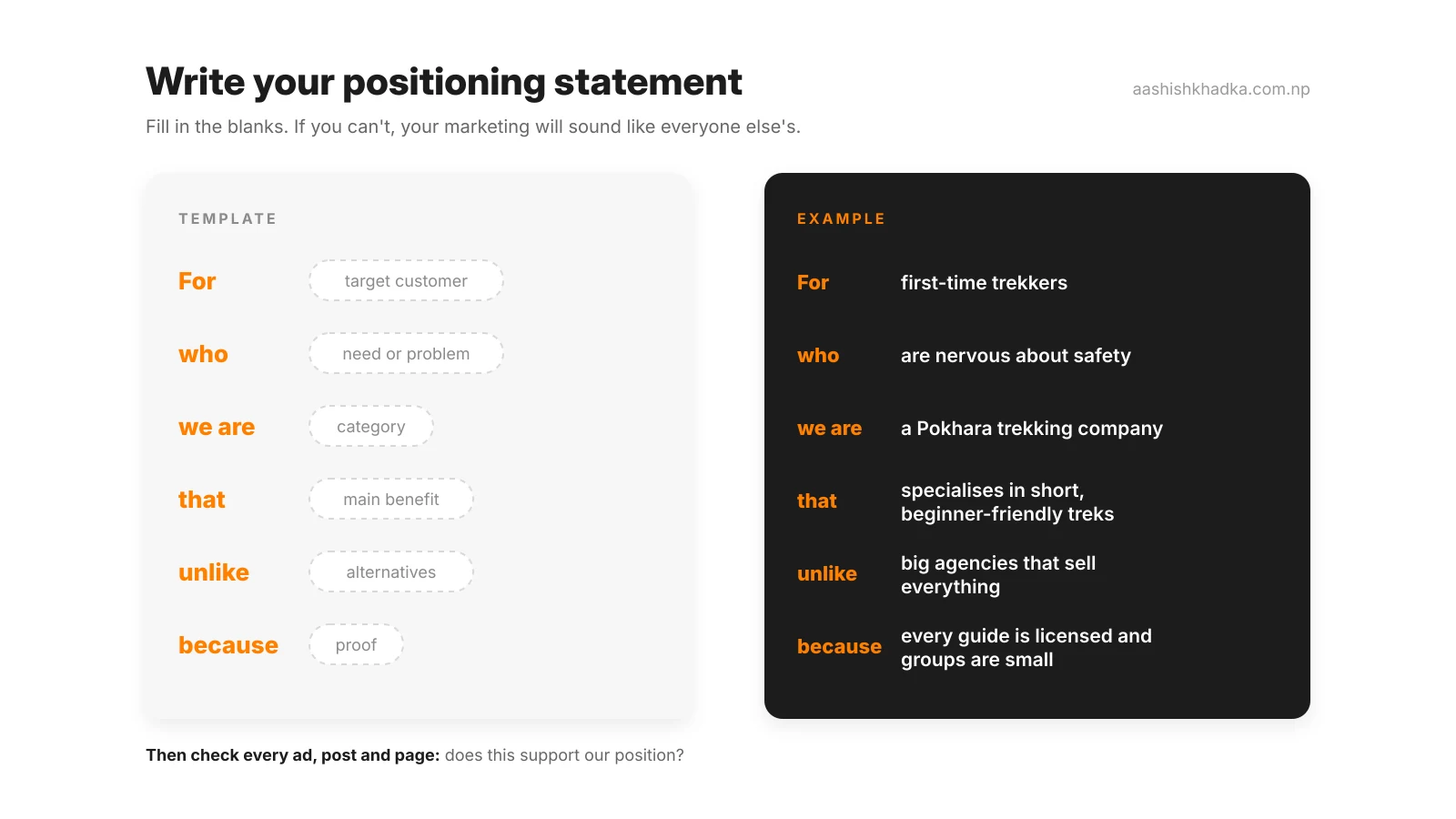
Positioning is the place you hold in your customer's mind compared with your competitors. It answers one question: "Why should I choose you?" A simple way to write it:
For [target customer] who [need or problem], we are [category] that [main benefit], unlike [alternatives], because [proof].
Why it matters for digital marketers
Positioning decides almost everything you do online: your keywords, your ad angles, your content topics, your visuals and even which platforms you use. Without it, customers put you in the "just another option" box, and then you can only compete on price.
Example
For first-time trekkers who are nervous about safety, we are a Pokhara trekking company that specialises in short, beginner-friendly treks, unlike big agencies that sell everything, because every guide is licensed and groups are kept small.
With this positioning, the company targets searches like "best trek for beginners in Nepal", makes content about safety and preparation, and shows small-group photos. It doesn't waste money competing for "cheapest Everest Base Camp trek".
Common mistake
Trying to be "the best" at everything for everyone. "Best quality, best price, best service" is not positioning. Everyone says it, so it means nothing.
How to apply it
Use your research (fundamental 2) and competitor table (fundamental 4).
Find something that matters to your target customer and that competitors don't own.
Fill in the positioning statement above.
Check every ad, post and page against it: does this support our position?
6. Value Proposition and Offer: Make It Easy to Say Yes
What it is
Your value proposition is the main reason someone should buy from you. Your offer is the specific deal you put in front of them: what they get, at what price, with what guarantee, and why now.
Part of the offer | Example for a homestay |
|---|---|
What they get | 2 nights, breakfast, local village walk |
The price | NPR price, clearly shown |
A reason to act now | Festival-season dates filling fast (only if true) |
Risk reduction | Free cancellation up to 7 days before |
Proof | Reviews from real guests |
Why it matters for digital marketers
Many campaigns fail because the offer is weak, not the ads. Better targeting and nicer designs can't save an offer nobody wants. A strong offer makes every channel work better: ads get cheaper clicks, posts get more messages, and landing pages convert more.
Example
"Visit our homestay" is not an offer. "2 nights with breakfast and a guided village walk, NPR [price] per person, free cancellation up to 7 days before" is. The second version answers every question a traveller has before they even message.
Common mistake
Using discounts as the only offer. Constant discounts train customers to wait for sales and make your business look cheap. Adding value (an extra service, a guarantee, a bonus) often works better than cutting the price.
How to apply it
Write your offer using the five parts in the table above.
Ask: would I say yes to this if I were the customer?
Remove risk: free cancellation, a free first session, or a clear guarantee.
Test two versions of the offer with the same audience and keep the winner.
Your offer also needs a page that converts. Use my on-page SEO checklist to build it.
7. Messaging and Copywriting: Clear Beats Clever
What it is
Copywriting is writing words that make people take action: headlines, ad text, captions, page content, emails and messages. Messaging is deciding what to say; copywriting is how you say it.
A feature is what something is. A benefit is what it does for the customer. People buy benefits.
Feature | Benefit |
|---|---|
Rooftop restaurant | Breakfast with a view of Machhapuchhre |
24/7 gym access | Train before work or after late shifts, whenever suits you |
Licensed guides | Your family stays safe on the trail |
Mobile-friendly website | Customers can book from their phone in under a minute |
Why it matters for digital marketers
You can have the right audience, the right offer and a big budget, and still fail because the message is confusing. Most people only read the first line of an ad or post. Copy decides whether they read the second.
Example
The PAS framework (Problem → Agitate → Solution) for a gym:
Problem: "Signed up for a gym and stopped going after two weeks?" Agitate: "It's not willpower. Most gyms give you a key card and leave you alone." Solution: "Our coaches build your plan and check in every week. First week free."
For longer content like landing pages, use AIDA: Attention → Interest → Desire → Action.
Common mistake
Trying to sound clever or "premium" with vague words: "Elevate your experience with our world-class solutions." Nobody knows what that means, so nobody acts.
How to apply it
After every feature, ask "so what?" until you reach something the customer cares about.
Say one message per ad or post.
Use your customers' own words from your research.
Be specific: "Helped 60+ businesses" beats "lots of happy clients".
End with one clear action: "Message us on WhatsApp", not "Contact us for more info".
For content that also ranks on Google, see how to write SEO content Google trusts.
8. The Marketing Mix: Marketing Is More Than Promotion
What it is
The marketing mix is the set of things a business controls to win customers. The classic version is the 4 Ps. Service businesses add 3 more, making the 7 Ps.
P | Question to ask | Example of a problem ads can't fix |
|---|---|---|
Product | Does it solve the customer's problem well? | A restaurant with bad reviews about the food |
Price | Is it right for the target customer and the value? | Premium prices with a budget-looking website |
Place | Can customers easily find and buy it? | No online booking, only a phone nobody answers |
Promotion | Are we telling the right people the right message? | (This is where ads and content come in) |
People | Do staff deliver a good experience? | Rude replies to Facebook messages |
Process | Is buying easy and smooth? | A 10-step booking form on mobile |
Physical evidence | Does everything look trustworthy? | Old photos, a broken website, no reviews |
Why it matters for digital marketers
Most digital marketers only control promotion. But promotion can't fix problems in the other Ps. Sending more traffic to a bad product or a broken booking process just wastes money faster, and then the ads get blamed.
Example
A restaurant asks for Instagram ads because "sales are down". A quick look shows a 3.6-star Google rating with repeated complaints about slow service. More ads would bring more people to a bad experience, and more bad reviews. The right first step is fixing the service (People and Process), then promoting.
Common mistake
Agreeing to run ads without checking the other six Ps first.
How to apply it
Before any campaign, go through all 7 Ps with the business owner.
Note which ones are weak.
Fix the cheap, fast ones first: photos, booking process, reply speed.
Only then scale promotion.
9. The Customer Journey: Meet People Where They Are
What it is
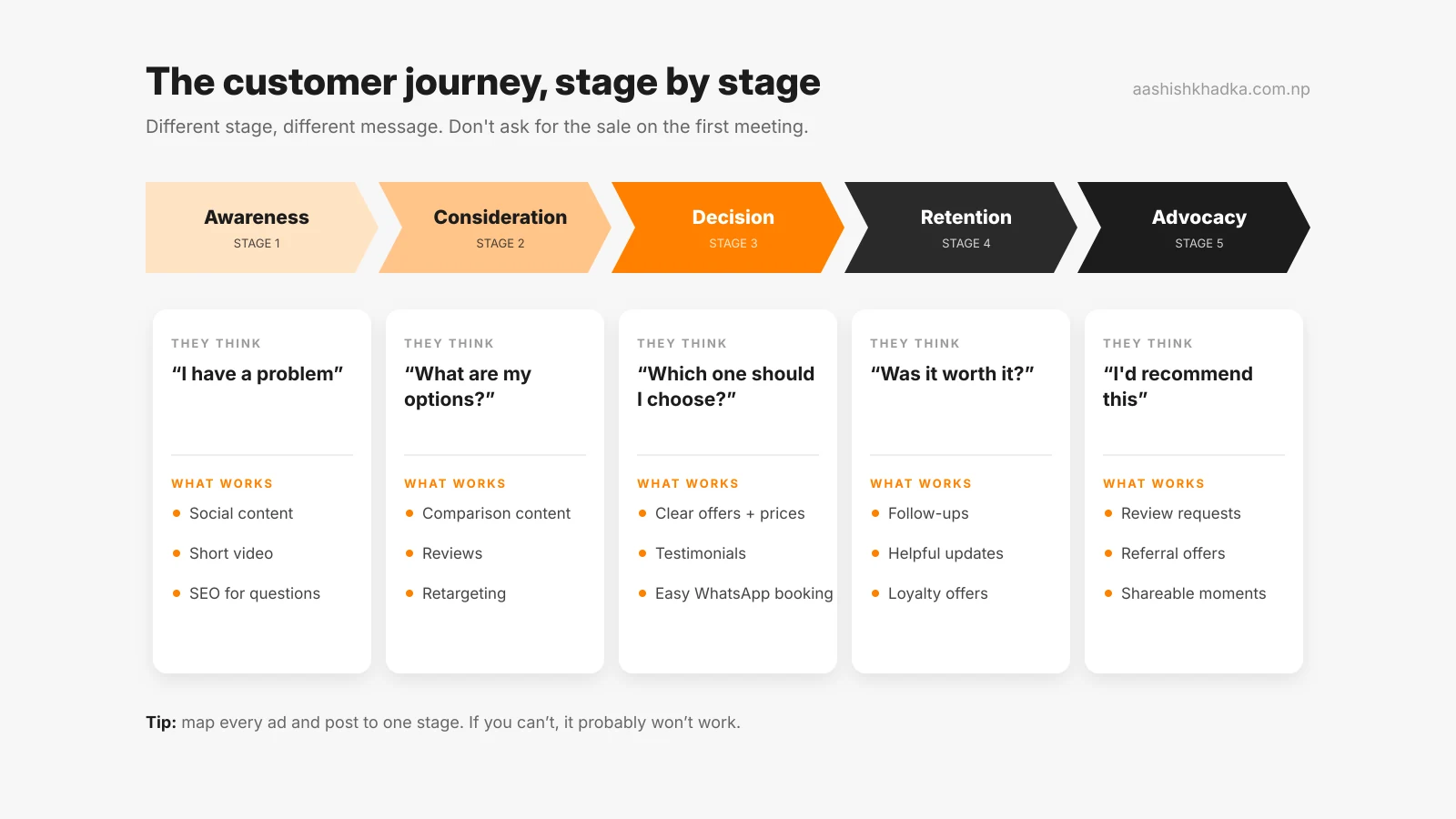
The customer journey is the path someone takes from first noticing a problem to buying, and ideally to coming back and recommending you. You'll also hear it called the marketing funnel.
Stage | What the customer is thinking | What works digitally |
|---|---|---|
Awareness | "I have a problem" or "I'm planning a trip" | Social content, short video, SEO for informational searches, reach ads |
Consideration | "What are my options?" | Comparison content, reviews, case studies, retargeting |
Decision | "Which one should I choose?" | Clear offers, prices, testimonials, an easy way to book or message |
Retention | "Was it worth it?" | Follow-ups, helpful content, loyalty offers |
Advocacy | "I'd recommend this" | Review requests, referral offers, shareable moments |
Why it matters for digital marketers
Each stage needs a different message, format and goal. If you use the same "Buy now" message for everyone, you lose the people who aren't ready yet, which is usually most of them.
Example
A trekking company plans content for a traveller in Europe:
Awareness: a reel showing the sunrise at Poon Hill ("Did you know this view is only 4 days from Pokhara?")
Consideration: a blog post comparing Poon Hill and Mardi Himal
Decision: a retargeting ad with the price, dates and reviews
Retention and advocacy: after the trek, a thank-you message with photos and a review link
People at the awareness stage often start with a Google search. Learn how SEO works.
Common mistake
Running "Book now!" ads to people who've never heard of you. It's like proposing marriage on the first meeting.
How to apply it
Draw the five stages for your business.
Write what your customer thinks and needs at each stage.
Map your current content and ads to each stage, and spot the empty ones.
Use retargeting to move people who engaged with awareness content towards a decision.
10. Brand vs Performance Marketing: Build Demand, Don't Just Capture It
What it is
Brand marketing | Performance marketing | |
|---|---|---|
Goal | Make people know, like and remember you | Get an action now: click, call, booking, sale |
Examples | Storytelling content, consistent visuals, community, PR | Search ads, conversion ads, retargeting, promo campaigns |
Results | Slow, long-lasting | Fast, stop when spending stops |
Measured by | Branded searches, reach, recall, direct traffic | Leads, sales, cost per result |
Why it matters for digital marketers
Performance marketing captures people who are already looking. Brand marketing makes more people look for you in the first place. Marketing effectiveness researchers Les Binet and Peter Field found that for many brands, a balance of roughly 60% brand and 40% performance works best over the long term. The right split depends on your business, but if you only do performance marketing, you'll keep paying more and more for the same small pool of ready-to-buy customers.
Example
A cafe only runs "20% off today" ads. Sales jump when ads run and drop when they stop. A competing cafe posts consistent, recognisable content about its baristas, its coffee from Nepali farms and its regulars. Over a year, people start searching for that cafe by name, and those customers cost almost nothing to win.
Common mistake
Judging brand content by immediate sales, then cutting it because "it didn't convert".
How to apply it
Keep some budget and time for brand building, even for a small business.
For small local businesses, "brand" can simply mean a consistent look and helpful content across Google, Instagram and your website.
Track brand signals: searches for your business name, direct website visits, people saying "I've seen your posts".
Use performance campaigns to capture the demand your brand creates.
11. Buyer Psychology: How People Really Decide
What it is
People like to think they decide logically. In reality, emotions and mental shortcuts play a big part. Psychologist Robert Cialdini described principles of persuasion that marketers still use every day.
Principle | What it means | Ethical example |
|---|---|---|
Social proof | We follow what others do | Real Google reviews and the number of happy customers |
Authority | We trust experts | A licensed guide's credentials, a doctor's qualifications |
Reciprocity | We want to return favours | A free checklist, a free consultation, useful content |
Scarcity | We want what's limited | "Only 4 seats left for the October group" (only if true) |
Commitment | We stay consistent with small steps | A free consultation before a big package |
Liking | We buy from people we like | Showing the real team and the story behind the business |
Two more worth knowing: loss aversion (people feel losses more than gains) and choice overload (too many options slow people down).
Why it matters for digital marketers
Online, people decide fast and with little information. These principles help them feel confident enough to act: reviews reduce fear, a free first step reduces risk, and a clear choice reduces confusion.
Example
A trekking company's booking page shows 10 different packages, no reviews and no guide information. A competitor shows three clear options, a review count near the button, guide profiles with licence details, and "Free consultation call". The second page uses choice simplicity, social proof, authority and commitment, and gets far more enquiries.
Common mistake
Using psychology to trick people: fake countdown timers, fake "only 2 left", fake reviews, hidden costs. It might work once, but it destroys trust, and on platforms like Google it can break the rules.
How to apply it
Put real reviews near every call to action.
Show credentials, experience and real team photos.
Offer a small free first step before the big purchase.
Limit choices to two or three clear options.
Only use scarcity when it's true.
12. Pricing: Price Is Part of Your Message
What it is
Pricing is deciding what to charge and how to present it. Price doesn't only decide profit. It tells customers what to expect.
Pricing idea | What it means | Example |
|---|---|---|
Value-based pricing | Price by the value to the customer, not just your cost | A website that brings enquiries is worth more than "5 pages of design" |
Anchoring | The first price people see shapes how they judge the others | Showing the premium package first makes the standard one feel reasonable |
Good, better, best | Three options make choosing easier | Basic, standard and premium trek packages |
Show your prices | Hidden prices make people leave and ask competitors | NPR and USD prices on tourism pages |
Why it matters for digital marketers
Your message must match your price. Premium prices need premium proof: great photos, strong reviews, a professional website. Cheap prices with luxury messaging confuse people too. Price also affects your ad costs: low-priced products leave less room to pay for each customer.
Example
A very cheap trekking package can make travellers wonder what's being cut: safety, insurance, guide quality? A company that charges more but explains clearly what's included (licensed guide, insurance, permits, small groups) usually attracts fewer price-shoppers and more serious bookings.
Common mistake
Competing only on price. Someone will always be cheaper, and a price war leaves no money for marketing, service or growth.
How to apply it
Know your costs and the minimum profit you need per sale.
Research what competitors charge and what's included.
Price based on the value to the customer, then explain that value clearly.
Offer 2–3 options, and show prices openly where possible.
13. Unit Economics: Is Your Marketing Actually Profitable?
What it is
Unit economics means looking at the money for one customer: what it costs to win them, and what they bring you.
Term | Simple meaning | Formula |
|---|---|---|
CAC (customer acquisition cost) | What it costs to win one new customer | Total marketing cost ÷ new customers |
AOV (average order value) | What a customer spends per purchase | Total revenue ÷ number of orders |
LTV (customer lifetime value) | The profit a customer brings over the whole relationship | Average profit per purchase × number of purchases |
ROAS (return on ad spend) | Revenue for every rupee spent on ads | Ad revenue ÷ ad spend |
Why it matters for digital marketers
Likes, reach and even sales mean nothing if each customer costs more to win than they're worth. Business owners care about profit, so a marketer who understands unit economics can talk to them in their language and make better budget decisions.
Example
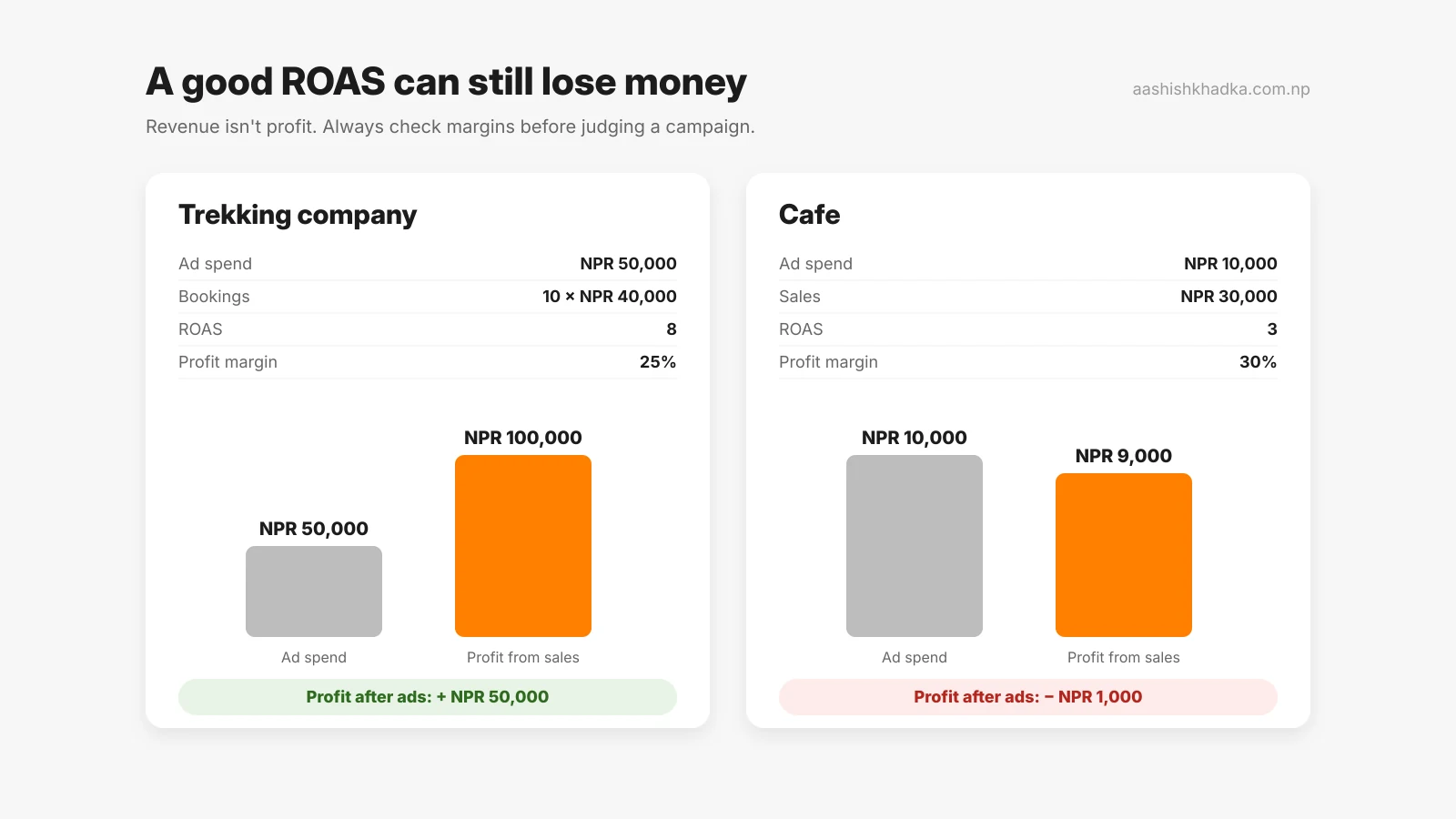
A trekking company spends NPR 50,000 on ads in a month and gets 10 bookings, each worth NPR 40,000.
CAC = 50,000 ÷ 10 = NPR 5,000 per customer
Revenue = 10 × 40,000 = NPR 400,000
ROAS = 400,000 ÷ 50,000 = 8
If the company keeps 25% of each booking as profit (NPR 10,000), each customer brings NPR 10,000 and costs NPR 5,000. Healthy.
Now a cafe spends NPR 10,000 on ads and gets NPR 30,000 in sales (ROAS 3). If its profit margin is 30%, that's only NPR 9,000 profit, so it lost NPR 1,000, even though ROAS looked fine. But if those new customers keep coming back every week, their lifetime value can make the campaign worth it.
Common mistake
Judging campaigns by ROAS or revenue alone, without knowing the profit margin or how often customers come back.
How to apply it
Ask the business for its average profit margin.
Calculate your maximum affordable CAC: the profit a customer brings (first purchase, or lifetime if they return).
Track CAC every month, not just clicks and reach.
Aim for LTV comfortably higher than CAC.
14. Marketing Doesn't End at the Lead: Sales and Follow-Up
What it is
A lead is someone who has shown interest: a message, a call, a form. Sales and follow-up is everything that happens next, until they become a customer (or clearly say no).
Stage | What good looks like |
|---|---|
First reply | Fast, friendly and personal. Answer the question, then ask one about their needs |
Qualifying | Understand their dates, budget, group size or goal before sending a price |
The offer | A clear recommendation, the price, what's included and the next step |
Follow-up | A polite check-in after a day or two if they go quiet, and again later with something useful |
Tracking | Every lead in a simple sheet or CRM: source, date, status, outcome |
Why it matters for digital marketers
You're judged on results, not on leads. Interest drops quickly, and people often message several businesses at once, so slow or careless replies waste the money spent on marketing. Feedback from sales also tells you which campaigns bring good leads and which bring time-wasters.
Example
An ad brings a WhatsApp enquiry for a trek. The business replies the next day with only "Price is NPR 25,000". No question about dates, no details, no follow-up. The traveller books with a competitor who replied in ten minutes with a friendly message, a short itinerary and a question about their dates. The first business then says "Facebook ads don't work".
Common mistake
Thinking your job ends when the lead arrives, and never checking what happened to it.
How to apply it
Write 3 reply templates: first reply, price reply, follow-up.
Agree a target reply time with whoever answers messages.
Track every lead for one month: source, reply time, outcome.
Use the results to calculate real CAC (fundamental 13) and improve targeting.
15. Retention and Word of Mouth: The Cheapest Growth There Is
What it is
Retention means keeping customers coming back. Word of mouth means customers bringing others. Together, they turn one sale into many.
Retention tactic | Example |
|---|---|
Follow up after the purchase | A WhatsApp message after a stay: "How was everything?" |
Ask for reviews | A direct Google review link sent to every customer |
Stay in touch | A useful monthly email or WhatsApp update, not spam |
Reward loyalty | A free coffee after 9 visits, a returning-guest discount |
Encourage referrals | "Bring a friend" offers for gyms and classes |
Reviews also help you rank on Google Maps. Read how to get reviews the right way.
Why it matters for digital marketers
Most digital marketing focuses on new customers. But existing customers already trust you, so winning them again is usually cheaper and easier. Their reviews and recommendations also make every future campaign more convincing.
Example
In Pokhara, guides, hotel staff and locals recommend businesses every day. A small restaurant that asks every happy guest for a Google review, remembers regulars and posts their photos (with permission) grows steadily, with a fraction of a competitor's ad budget.
Common mistake
Never collecting customer contacts, so there's no way to reach past customers again except by paying for ads.
How to apply it
Collect customer contacts with permission (WhatsApp, email).
Send a thank-you and review request after every purchase.
Plan one campaign a month just for past customers.
Create a simple referral reward.
16. Measurement and Testing: Decide With Data, Not Feelings
What it is
Measurement means tracking what your marketing actually achieves. Testing means trying variations to find what works better.
Vanity metrics | Business metrics |
|---|---|
Likes, reach, impressions, followers | Enquiries, bookings, sales, cost per customer, profit |
Why it matters for digital marketers
Good marketers aren't the ones who are always right. They're the ones who find out quickly when they're wrong. Without measurement, you can't prove your value, and you can't improve.
Also know the limits of tracking. A customer might see your Instagram post, search your name on Google a week later, and book through WhatsApp. Most tools give all the credit to the last step, so dashboards never show the full story.
Example
A gym runs two versions of an ad for two weeks. The only difference is the headline: "Get fit in 2027" vs "First week free, with a coach who checks in". The second gets twice the messages at the same cost. Next, they test the image, keeping the winning headline.
Common mistake
Celebrating vanity metrics, changing many things at once (so you don't know what worked), or stopping a test after one day.
How to apply it
Before any campaign, decide the one business metric that defines success.
Set up tracking first: GA4, conversion events, UTM links. My Google Search Console guide helps with search data.
Test one thing at a time: headline, or image, or audience.
Give each test enough time and data before deciding.
Ask every new customer, "How did you hear about us?"
Want a ready checklist for your pages? Download my free on-page SEO checklist template.
Putting It All Together: A One-Page Checklist Before Any Campaign
Before you open any ad platform or schedule a single post, you should be able to answer these questions:
# | Question | Fundamental |
|---|---|---|
1 | What problem does our customer have, and what outcome do they want? | Customer problem |
2 | What have real customers told us, in their own words? | Market research |
3 | Who exactly is our main customer? | Segmentation and targeting |
4 | What are competitors offering and saying, and what are they missing? | Competitor analysis |
5 | Why should customers choose us over competitors? | Positioning |
6 | What is our offer, and why act now? | Value proposition and offer |
7 | Is our message clear, benefit-led and in the customer's words? | Messaging and copywriting |
8 | Are the product, price, process and proof ready? | Marketing mix |
9 | Which stage of the journey is this campaign for? | Customer journey |
10 | Are we building demand, capturing it, or both? | Brand vs performance |
11 | What will make them trust us and decide? | Buyer psychology |
12 | Does our price match our message? | Pricing |
13 | What can we afford to pay per customer? | Unit economics |
14 | Who replies to leads, how fast, and how do we follow up? | Sales and follow-up |
15 | How will we keep customers and get referrals? | Retention |
16 | What will we measure, and how will we test? | Measurement |
If you can't answer most of these, more ad spend won't fix it. Go back to the fundamentals first.
Common Mistakes Digital Marketers Make
Mistake | The fundamental they missed |
|---|---|
Building campaigns on assumptions instead of talking to customers | Market research |
Running ads before the offer is clear | Value proposition and offer |
Targeting "everyone in Nepal" | Segmentation and targeting |
Sounding exactly like every competitor | Competitor analysis and positioning |
Listing features instead of benefits | Messaging and copywriting |
Sending "Book now" ads to people who've never heard of you | Customer journey |
Celebrating likes while sales stay flat | Measurement |
Judging campaigns by ROAS without knowing margins | Unit economics |
Getting enquiries but replying a day later | Sales and follow-up |
Only chasing new customers | Retention |
Blaming the ads when the real problem is the product or process | Marketing mix |
FAQs
What is the difference between marketing and digital marketing?
Marketing is understanding customers and creating, communicating and delivering value to them. Digital marketing is doing that through digital channels like search, social media, email and ads. The fundamentals are the same; only the tools are different.
Do I need to study marketing theory to be a good digital marketer?
You don't need a degree, but you do need the core ideas in this post. They're what separate someone who can run ads from someone who can grow a business.
What are the 4 Ps of marketing?
Product, price, place and promotion. Service businesses often add three more: people, process and physical evidence, making the 7 Ps.
What is a good CAC?
There's no single number. A good CAC is comfortably lower than the profit a customer brings you over time (their lifetime value). Many businesses aim for lifetime value at least a few times higher than CAC, but it depends on the industry.
Which marketing fundamental should I learn first?
Start with the customer: their problem, who they are and why they'd choose you (fundamentals 1 to 6). Everything else builds on that.
Key Marketing Terms in This Post
Term | Meaning |
|---|---|
Voice of customer | Customers' own words about their problems and needs |
STP | Segmentation, targeting and positioning |
Direct / indirect competitors | Same product for the same people / a different way to solve the same problem |
Positioning | The place you hold in customers' minds compared with competitors |
Value proposition | The main reason a customer should buy from you |
Features vs benefits | What something is vs what it does for the customer |
AIDA / PAS | Copywriting frameworks: Attention-Interest-Desire-Action / Problem-Agitate-Solution |
Marketing mix (4 Ps / 7 Ps) | Product, price, place, promotion (+ people, process, physical evidence) |
Customer journey | The stages from awareness to advocacy |
Brand marketing | Building long-term awareness and preference |
Performance marketing | Driving immediate, measurable actions |
Social proof | People following what others do, such as reviews |
CAC | Customer acquisition cost |
LTV | Customer lifetime value |
ROAS | Return on ad spend |
Lead | Someone who has shown interest, such as a message or form submission |
Vanity metrics | Numbers that look good but don't show business results |
Wrapping Up
Ads Manager, Google Ads and AI tools will look completely different in five years. These 16 fundamentals won't.
Learn them once and every campaign gets easier: you'll know who you're talking to, what to say, what to offer, and whether it's actually making money.
If you're just starting out, And if you run a business in Pokhara and want help applying these fundamentals, here's how I do digital marketing in Pokhara.
Need help applying these to your business? Get in touch.